
Mastering parking skills for new drivers is essential for passing your Ontario road test. DriveTest examiners evaluate your ability to park with precision, control, and full observation. Whether it is parallel parking, reverse parking, or angle parking, each technique requires deliberate practice and proper instruction. This guide covers every parking skill you need to succeed on test day.
Why Parking Skills Matter in Driving Tests
Parking is not a minor component of your Ontario road test. Examiners at DriveTest score candidates on specific parking maneuvers, and errors in this area are among the most common reasons drivers fail their G2 test. Research across Ontario road test centres confirms that improper parking technique, including failure to check blind spots and poor vehicle positioning, contributes to a significant percentage of road test failures province-wide each year.
Understanding what examiners look for gives you a measurable advantage. They assess your observation habits, steering control, distance from the curb, and how smoothly you complete each movement. A single critical error, such as mounting the curb or skipping a blind spot check, can result in automatic failure regardless of how well you performed elsewhere.
Parallel Parking Step-by-Step
Parallel parking is the maneuver most new drivers fear, yet it is one of the most consistently tested skills at DriveTest centres across Ontario. Follow these steps to build accuracy and confidence:
- Signal and pull up alongside the vehicle in front of the empty space.
- Align your rear bumper with the rear bumper of the lead vehicle.
- Begin reversing slowly while turning the steering wheel sharply toward the curb.
- When your front door aligns with the rear bumper of the lead vehicle, straighten the wheel.
- Continue reversing, then turn the steering wheel away from the curb to center the vehicle.
- Adjust forward and backward until you are within 30 centimeters of the curb.
Practice this sequence in an empty parking lot before attempting it in active traffic. Lane discipline and spatial awareness are essential throughout every stage of the maneuver.
Reverse Parking and Angle Parking
Reverse parking, also known as backing into a stall, is increasingly included on Ontario road tests and is a skill you will use daily as a licensed driver. To reverse park correctly:
- Check your mirrors and physically check blind spots before initiating any reverse movement.
- Enter the stall slowly, correcting your steering gradually as the vehicle tracks into position.
- Ensure the vehicle is centered and straight within the marked stall lines.
Angle parking is typically performed in parking lots and requires smooth, controlled turns at reduced speed. Approach the space with your signal on, confirm no pedestrians are in your path, and enter the stall deliberately without oversteering.
Both techniques rely on consistent mirror checks and full awareness of your surroundings at all times. If you are working to build confidence with these maneuvers, driving lessons in Ottawa with a certified instructor provide the structured repetition and feedback needed to develop lasting accuracy.
Common Parking Mistakes That Cause Failure
Many new drivers repeat the same avoidable errors during their road test. Knowing these in advance allows you to eliminate them before test day. The most common parking mistakes include:
- Failing to signal before moving into or out of a parking space
- Not performing blind spot checks before reversing
- Parking more than 30 centimeters from the curb
- Allowing the vehicle to roll forward during reverse maneuvers
- Neglecting to straighten the wheels after parking on an incline
- Rushing through the maneuver under the pressure of the test environment
Road safety depends on precision and situational awareness at every stage of a maneuver. Examiners look for consistency and observation, not flawless speed. However, repeated errors or any single critical mistake will result in a failed test result.
How to Practice Parking Efficiently
Effective practice is deliberate and structured, not simply repetitive. Repeating a maneuver without feedback rarely produces meaningful improvement. Use these targeted strategies to develop real skill:
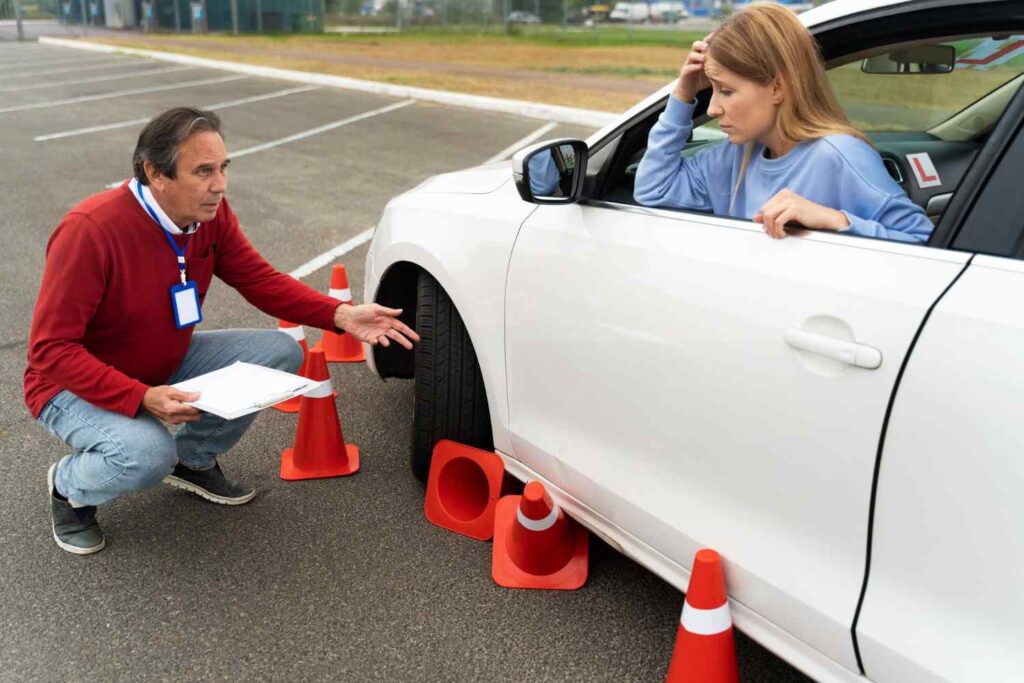
- Practice in an empty lot using cones or markers to simulate actual parking boundaries.
- Film your attempts from outside the vehicle to identify consistent positioning errors.
- Gradually introduce realistic conditions, including tighter spaces and busier environments.
- Focus on one parking type at a time. Master parallel parking before progressing to reverse stalls.
If you are building your driving skills from the beginning, driving lessons for beginners offer a structured, low-pressure setting where you can develop these foundational techniques under expert guidance before facing real test conditions.
Professional Training Improves Parking Accuracy
Self-directed practice has limitations. A certified driving instructor identifies errors you are unlikely to spot on your own, corrects your technique before habits become fixed, and prepares you for the precise conditions you will face on your road test route.
As a trusted driving school in Ottawa, Steer’nGo pairs each student with a certified instructor who tailors every lesson to their specific learning needs. Whether you are struggling with parallel parking accuracy or need confidence in reverse stall entry, professional instruction builds the muscle memory and awareness that one-time driving practice cannot.
For dedicated parking practice for road test readiness, our G2 and G preparation program covers every evaluated maneuver in precise detail, using routes and test conditions that mirror what you will face at your Ottawa DriveTest centre.
Ontario’s graduated licensing system, as outlined by the Ministry of Transportation, is designed to ensure new drivers build competence progressively before earning full driving privileges. Investing in proper training is the most reliable path to passing your road test on the first attempt and becoming a safe, independent driver.
Take Your Parking Skills From Practice to Test-Ready
Parking is a skill that demands patience, structured repetition, and quality instruction. From parallel parking to reverse stalls, every maneuver you master brings you measurably closer to a successful road test. Do not leave your preparation to chance or to self-assessment alone. To book a parking practice session with one of our certified Ottawa driving instructors, contact Steer’nGo today and begin building the skills that will carry you through your road test and every drive that follows.
Frequently Asked Questions
What parking skills are tested on the Ontario G2 road test?
The G2 road test evaluates parallel parking, angle parking, and reverse parking maneuvers. Examiners assess your blind spot checks, vehicle positioning, distance from the curb, and the smoothness of every completed step.
How close to the curb must I park to pass my driving test?
Ontario road test standards require your vehicle to be parked within 30 centimeters of the curb. Parking farther away or making contact with the curb results in point deductions or, in severe cases, automatic test failure.
How many practice sessions does it typically take to master parallel parking?
Most new drivers require between 10 and 20 focused practice sessions to feel test-ready with parallel parking. Lessons with a certified instructor who provides real-time feedback significantly reduce the sessions needed.
Can I fail my road test solely because of parking errors?
Yes. A critical parking error, such as mounting the curb, omitting blind spot checks, or stopping in an unsafe position, can trigger automatic failure. Multiple minor parking errors across the test also accumulate toward a failed result.
Is angle parking always included on the Ontario road test?
Angle parking is not guaranteed on every test but may be included depending on your specific route and examiner. Preparing for all parking types ensures you are fully ready regardless of which maneuvers appear on your test day.