
The most avoidable Ontario driving test mistakes happen in the weeks before the exam, not during it. Practicing without instructor feedback, neglecting highway skills, compressing lesson schedules, and skipping mock tests are the four preparation errors that consistently predict failure. Each one is correctable – and fixing them before you book dramatically improves your first-time pass rate.
Stop Practicing Without Feedback
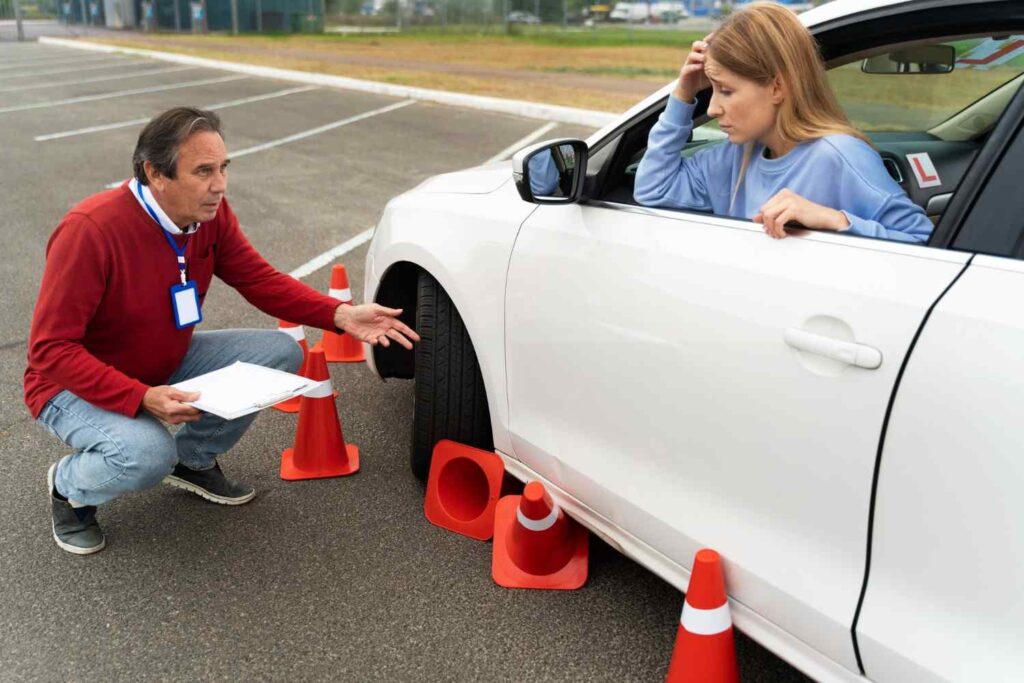
Many Ontario driving test failures trace back to habits that formed quietly during unsupervised practice. Without a qualified instructor in the vehicle, errors go unnoticed and eventually become automatic. Structured feedback from a certified instructor is the most reliable way to catch and correct those habits before an examiner does.
Why Unsupervised Practice Reinforces Bad Habits
The most common preparation mistake is treating supervised drives the same as structured lesson time. Driving laps around familiar neighborhoods with a parent or friend is useful for building comfort and seat time – but it doesn’t correct bad habits. It reinforces them.
Without expert feedback, small errors become invisible patterns. A driver who consistently drifts slightly in turns, taps the brake too late approaching intersections, or fails to complete shoulder checks before pulling from the curb may not hear about those issues until the examiner records them on a score sheet.
Ontario’s road test evaluation criteria, as set out by the Ministry of Transportation, are specific and scored. Examiners are not grading impressions – they are tracking defined behaviours at defined moments. If those behaviours haven’t been corrected before test day, they won’t magically correct themselves under pressure.
This is exactly what structured instruction with a certified instructor solves. Our certified driving instructors in Ottawa track your improvement across sessions, identify recurring errors, and give you corrective cues in real time – the kind of feedback that actually changes your driving, not just your awareness of it.
Don’t Ignore Highway Practice Before a G Test
The G road test assesses a specific set of skills that can only develop through dedicated highway driving. Yet most G2 drivers spend the majority of their preparation on residential and urban roads, which leaves a significant gap on test day. Closing that gap requires deliberate, structured highway sessions before you book your test.
Why Highway Avoidance Is a Test-Day Risk
The full G road test includes a highway segment. For many drivers upgrading from a G2, this is the weakest part of their skill set – because it’s the segment most people avoid practicing.
Highway driving requires a different kind of confidence than residential or urban driving. Merging at speed, maintaining lane position at 100 km/h, executing safe passes, and reading traffic flow far ahead are all skills that require dedicated repetition to feel intuitive. You cannot replicate highway conditions in a parking lot or on a quiet street.
DriveTest evaluators specifically assess how confidently and safely you merge, how smoothly you adjust speed, and whether your lane changes demonstrate proper scanning and signaling. Drivers who have only practiced in local traffic often freeze or hesitate on the ramp – and hesitation at highway entry is one of the most penalized behaviours in a G test.
Our G road test coaching in Ottawa includes specific highway modules on Ottawa’s major expressways, mirroring the conditions you’ll encounter during your actual G test. We build this practice into your lesson plan before you’re anywhere near a test booking.
Avoid Last-Minute Cram Sessions
Booking several back-to-back lessons in the final days before your test might feel productive, but it rarely improves results. Driving is a physical skill that requires time between sessions for new habits to settle into automatic behaviour. Understanding why spacing matters will help you build a preparation timeline that actually works in your favour.
Why Muscle Memory Cannot Be Rushed
Driving is a physical skill. It is encoded through repetition over time, not through a marathon session the day before your test.
Cramming works for memorization-based tasks. It does not work for muscle memory, spatial judgment, or decision-making under pressure – all of which your road test evaluates. A driver who takes eight lessons spread over six weeks will almost always outperform a driver who takes the same eight lessons in a compressed two-week rush.
Spacing out your training gives skills time to settle. Mirror checks become automatic. Intersection timing becomes instinctive. Lane positioning happens without deliberate thought. That level of automaticity is what examiners expect to see in a driver ready for an unsupervised licence.
If your test is approaching faster than you’d like, the right move is not to double down on back-to-back lessons. It’s to have an honest conversation with your instructor about whether you’re genuinely ready or whether rescheduling gives you a better shot at passing on the first attempt. A rescheduled test costs far less than a failed one.
Take a Full Mock Test Before Booking
A mock test is the single most underutilized preparation tool among Ontario road test candidates. It is also one of the most effective.
The data underscores why this matters. According to DriveTest Ontario pass rate data obtained by CBC through a Freedom of Information request, the provincial average pass rate across all Ontario DriveTest centres was 69% in 2022 – meaning nearly 1 in 3 candidates failed. In high-demand urban centres, that failure rate climbs significantly higher. A full mock test is the most reliable way to ensure you are not among them.
Running a full simulated test – the same duration, the same route types, the same evaluation pressure as the real exam – does several things simultaneously:
It Reveals Your Actual Weak Points
You may feel confident in lessons when the instructor is guiding you through each maneuver with cues. A mock test removes those cues and shows you where your skill becomes inconsistent without prompting.
It Normalizes the Pressure
Test anxiety is a real performance factor. Drivers who have already experienced the sensation of being evaluated while driving – with an instructor sitting silently, recording observations – are measurably less reactive on the real test day.
It Answers the Readiness Question Honestly
If you complete a mock test and your instructor marks a passing score, you have objective evidence you’re ready. If you don’t, you have a clear picture of exactly what needs more work before you book.
Don’t walk into your DriveTest appointment wondering whether you’re ready. Know before you go.
The Right Preparation Makes All the Difference
The drivers who consistently pass their Ontario road tests on the first attempt share a few things in common: they trained with structured feedback, they practiced the skills that made them nervous rather than avoiding them, they spread their training over time, and they ran at least one full mock test before booking.
None of that is complicated. All of it is achievable with the right guidance.
At Steer’nGo, we build every student’s preparation plan around these principles – from the first lesson to the final mock test. If your test is coming up and you want a realistic evaluation of where you stand, we’re here to help. Book your final road test evaluation with our Ottawa team today.
Frequently Asked Questions
What are the most common reasons drivers fail their Ontario road test?
The most frequent failures involve incomplete stops at intersections, missed mirror and blind-spot checks, inconsistent speed management, and poor lane discipline. These are habitual errors that form during unsupervised practice and are best corrected through instructor-guided feedback sessions.
How many mock tests should I complete before booking my real road test?
Complete at least one full mock test before booking. If significant errors surface, do targeted practice and run a second mock. A clean passing score from your instructor is the clearest indication you are genuinely ready to book.
Does practicing with family members prepare me enough for my G road test?
Family practice builds seat time but does not correct bad habits. Without expert feedback, errors become automatic. A certified instructor identifies and corrects recurring issues that family supervisors are often unqualified or unequipped to address.
Should I reschedule my road test if I don’t feel fully prepared?
Yes. A rescheduled test costs nothing compared to paying a non-refundable re-test fee and waiting weeks for a new slot. If your mock test results or instructor’s assessment indicate you’re not ready, rescheduling is the smarter financial decision.
How long before my test should I stop introducing new driving content?
Stop introducing new maneuvers at least 3 to 4 days before your test. Your final session should be a review and confidence-building drive, not new instruction. This gives your existing skills time to consolidate before the pressure of the real exam.